The FTC is reportedly investigating Instacart over its AI pricing tool

The Federal Trade Commission has sent Instacart a civil investigative demand, seeking information about its AI-powered pricing tool, according to Reuters. This comes after a recently published pricing experiment study showed that the online grocery delivery app gave different users different prices for the same items from the same store location at the exact same time. Some of the testers saw prices up to 23 percent higher than what the other testers saw, though the average difference for the same list of items was around 7 percent. Those higher prices could cost customers over $1,000 more in expenses for the year.

“The Federal Trade Commission has a longstanding policy of not commenting on any potential or ongoing investigations,” the FTC told Reuters in a statement. “But, like so many Americans, we are disturbed by what we have read in the press about Instacart’s alleged pricing practices.”

When the study came out, Instacart told Engadget that the pricing variances were caused by some of its retail partners doing “limited, short-term and randomized tests” to better understand consumers. Those randomized pricing tests were enabled by Instacart’s AI pricing tool called Eversight developed by a company it purchased in 2022. Instacart told CNBC that “much of what’s been reported has mischaracterized how pricing works” on its platform. The spokesperson repeated that retailers conduct pricing tests on its app and said that “prices on Instacart do not change in real time,” aren’t based on supply or demand and that it never uses “personal, demographic, or user-level behavioral data to set item prices.”

This article originally appeared on Engadget at https://www.engadget.com/apps/the-ftc-is-reportedly-investigating-instacart-over-its-ai-pricing-tool-130000472.html?src=rss 

Ultrahuman brings snoring detection and respiratory health tracking to the Ring Air

The Ultrahuman Ring Air now has the capacity to track snoring and general respiratory health. This is thanks to proprietary technology called Respiratory Health PowerPlug, which is basically a suite of audio analysis tools along with some “advanced biomarker tracking” and AI tomfoolery.

All of this results in “one of the most comprehensive consumer tools ever built for understanding nighttime respiratory stability.” It details snoring sessions, of course, but also delivers a holistic and “actionable sleep picture.” The company says this “reveals patterns, trends and changes in respiratory health over time.”

Ultrahuman

To that end, it can also detect coughing and respiratory disturbances. This data is cross-referenced with movement patterns, sleep fragmentation patterns and resting heart rate to “show exactly how breathing issues shape sleep quality.” The company says this can be a good resource when experimenting with interventions, like switching to a new pillow or taping up the nose.

More health data is never a bad thing, but this information isn’t free. Ultrahuman is charging $4 per month for access to the tool, though folks can pick up an annual subscription for $40.

The Ultrahuman Ring Air made our list of the best smart rings, and that was before the company introduced this new software. It tracks an impressive amount of data and integrates with third-party devices like glucose monitors.

This article originally appeared on Engadget at https://www.engadget.com/wearables/ultrahuman-brings-snoring-detection-and-respiratory-health-tracking-to-the-ring-air-130054901.html?src=rss 

OpenAI just launched an app store inside ChatGPT

OpenAI has introduced an app directory that’s now available right inside ChatGPT, the company announced. “Apps extend ChatGPT conversations by bringing in new context and letting users take action like order groceries, turn an outline into a slide deck or search for an apartment,” the company wrote in a blog post. OpenAI also noted in a help document that “connector” apps like Google Drive are now simply called “apps.”

The new apps section (on iOS, Android and web) is divided into Feature, Lifestyle and Productivity categories, letting you connect to commonly used apps and sites like Booking.com, Spotify and Dropbox. To use an app, simply click on it, hit “Connect” then authorize the app to access ChatGPT. With that done, you can then start a chat related to that app. In the case of Dropbox, for instance, you’ll be able to “gather insights, prepare briefs and summarize reports or internal documents,” according to the description. Once connected, any app can be accessed by doing an @ mention of it.

A new addition that came along with the store is an Apple Music app that, like Spotify, helps users find music, create playlists and manage their libraries through a chat interface. Another is DoorDash, which lets you transform recipes, meal planning and staples into “an actionable shopping cart.”

Along with the app directory, OpenAI is now allowing developers to submit apps for review and publication in ChatGPT according to the company’s app submission guidelines. It also published resources to help developers build such apps, including best practices, open-source example apps, an open-sourced UI library for chat-native interfaces and a step-by-step quickstart guide. That’s on top of the software developer kit (SDK) that OpenAI introduced in October.

OpenAI noted that for now, developers can only monetize apps by linking out from the ChatGPT app to the native app or website — but the company is exploring internal monetization options as well. Privacy was also emphasized, with companies required to provide “clear” policies.

The new feature is a big part of Sam Altman’s promises to make ChatGPT more versatile with the addition of custom “GPT” bots. “Over time, we want apps in ChatGPT to feel like a natural extension of the conversation, helping people move from ideas to action, while building a thriving ecosystem for developers,” the company wrote.

This article originally appeared on Engadget at https://www.engadget.com/ai/openai-just-launched-an-app-store-inside-chatgpt-133049586.html?src=rss 

John Travolta’s Kids: Everything to Know About His 3 Children, Including the Late Jett

John Travolta is the proud dad of three children, including his late son Jett, daughter Ella, and son Benjamin. Find out more about them here.

John Travolta is the proud dad of three children, including his late son Jett, daughter Ella, and son Benjamin. Find out more about them here. 

Sony settles with Tencent over ‘slavish’ Horizon clone

Earlier this year Sony sued Tencent for copyright infringement over its Light of Motiram game, calling it a “slavish clone” of Horizon Zero Dawn. Then, earlier this month, Tencent agreed to stop promoting and publicly testing the game. Now, the two companies have reached a “confidential settlement” and the case has been dismissed, according to court documents seen by The Verge. Light of Motiram has also disappeared from Steam and Epic’s game stores. 

“SIE and Tencent are pleased to have reached a confidential resolution and will have no further public comment on this matter,” Tencent’s spokesperson told The Verge. 

When Sony first filed its lawsuit in July 2025, it said that Tencent’s game appeared to copy aspects of not just Horizon Zero Dawn, but other franchise games including Horizon Forbidden West and Lego Horizon Adventures. That included the post-apocalyptic setting with humans and machines coexisting, the visual appearance of characters and even the marketing materials — something Engadget certainly noticed when Tencent first announced the game.

This article originally appeared on Engadget at https://www.engadget.com/gaming/sony-settles-with-tencent-over-slavish-horizon-clone-120042886.html?src=rss 

Dolby and LG introduce a modular home audio system for CES 2026

LG is teaming up with Dolby for a new collection of speakers that the companies are unveiling ahead of CES 2026. The LG Sound Suite features a modular lineup the H7 soundbar, M7 and M5 wireless surround speakers and the W7 subwoofer. The speakers can be combined in more than two dozen different configurations, from a pair to a full 13.1.7 channel surround sound home theater setup.

The main pitch of the LG Sound Suite is its application of Dolby Atmos FlexConnect. This is the audio brand’s tech for optimizing sound from wherever wireless speakers are placed. It’s meant to deliver optimal sound even from unusual locations, even when you’re limited by outlet locations, furniture placement or other quirks of a room’s layout. The collaboration with LG brings FlexConnect to a soundbar for the first time. When the H7 soundbar is used as the lead device, the suite will bring Dolby Atmos FlexConnect audio to any television. In a future software update, LG will also bring support for Dolby Atmos FlexConnect directly to some of its premium TVs, including select 2025 models.

This article originally appeared on Engadget at https://www.engadget.com/audio/speakers/dolby-and-lg-introduce-a-modular-home-audio-system-for-ces-2026-010000126.html?src=rss 

China reportedly has a prototype EUV machine built by ex-ASML employees

A report from Reuters claims that scientists in China have created a prototype of a machine that could eventually be used to produce semiconductor chips capable of powering artificial intelligence. Sources told the publication that a team in Shenzhen completed the prototype of an extreme ultraviolet lithography machine earlier this year and it is allegedly now undergoing testing. The EUV machine was reportedly made by former engineers from Dutch semiconductor supplier ASML. Reuters states that China is targeting production of its own EUV chips beginning in 2028, although other experts have projected 2030 as a more likely date. 

EUV is a supremely complicated bit of technology; we have an explainer below that gets into some of the details. It is at the heart of the chips made by companies such as Intel and TSMC, so any company trying to compete would also need access to EUV. Although the Chinese prototype is not yet making chips, it is reportedly able to generate the extreme ultraviolet light needed for chip manufacturing.

If confirmed, this development would put China in control of tech much sooner than analysts had previously expected. To date, EUV has largely been kept out of reach by Western companies and used as a bargaining chip by the US government. Chinese President Xi Jinping has placed a high priority on the country being able to produce its own semiconductors. “The aim is for China to eventually be able to make advanced chips on machines that are entirely China-made,” a source told Reuters. “China wants the United States 100 percent kicked out of its supply chains.”

This article originally appeared on Engadget at https://www.engadget.com/big-tech/china-reportedly-has-a-prototype-euv-machine-built-by-ex-asml-employees-235833756.html?src=rss 

A Facebook test makes link-sharing a paid feature for creators

Creators and publishers have long worried about Meta’s ability to throttle links to outside content. Now, the company is testing out a new scheme that effectively puts link-sharing behind a paywall for creators on Facebook.

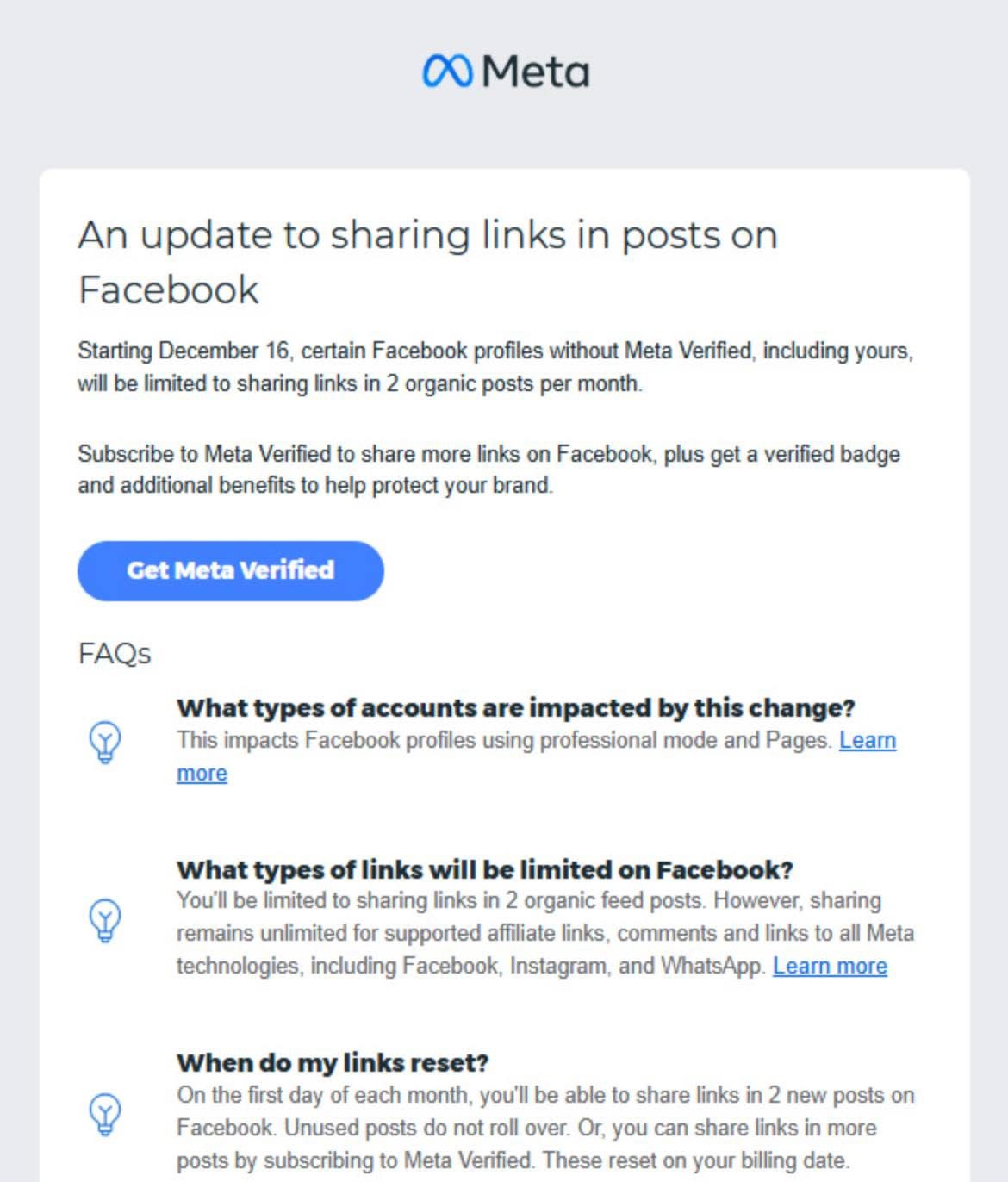
Under the test, a Meta Verified subscription will determine how many links a creator can share another profile per month. According to a screenshot shared by social meda consultant Matt Navarra, creators in the test recently received a notification from Meta informing them that “certain Facebook profiles without Meta Verified, including yours, will be limited to sharing links in 2 organic posts per month.”  

Meta is making link sharing pay to play with a new test.

A spokesperson for Meta confirmed the test to Engadget. The test is currently affecting an unspecified number of creators and pages using “professional mode” on Facebook. Publishers aren’t affected for now. “This is a limited test to understand whether the ability to publish an increased volume of posts with links adds additional value for Meta Verified subscribers,” the spokesperson said.

While Meta seems to be trying to downplay the significance of the test, it’s a notable shift for the company. Many creators and businesses rely on Facebook and reducing their ability to send traffic to outside websites could be a significant hit. Many creators are already frustrated that the company puts its better customer service features behind the Meta Verified subscription, which starts at $14.99/month. Making link-sharing a premium feature as well would be even more unpopular.

Have a tip for Karissa? You can reach her by email, on X, Bluesky, Threads, or send a message to @karissabe.51 to chat confidentially on Signal.

This article originally appeared on Engadget at https://www.engadget.com/social-media/a-facebook-test-makes-link-sharing-a-paid-feature-for-creators-224632957.html?src=rss 

The first post-EA FIFA soccer sim will be a Netflix Games exclusive

FIFA’s first true soccer sim after the end of its EA partnership will be available exclusively on Netflix, the streaming service announced. This “reimagined FIFA football simulation game” will be developed and published by Delphi Interactive, and be available to Netflix subscribers next year, right in time for FIFA World Cup 2026.

EA and FIFA maintained a nearly 30 year partnership creating soccer games before they parted ways in 2022. EA continued its soccer series afterward as EA FC, but despite being in talks with “leading game publishers, media companies and investors” about “a major new FIFA simulation football game title for 2024,” a FIFA-backed competitor has yet to materialize. Instead, FIFA has mostly supported arcade soccer games in the last few years, like FIFA Rivals from Mythical Games and FIFA Heroes from ENVER.

While the game Delphi Interactive is working on is pitched as a “simulation game,” based on what little detail appears in Netflix’s announcement, it doesn’t sound like it’s targeting hardcore soccer fans in the same way EA’s games do. Instead, this new FIFA title is designed to be “a game that anyone, anywhere, can pick up and instantly feel the magic of football,” according to Delphi Interactive CEO Caspar Daugaard. The game will also be designed to use a smartphone as a controller, possibly limiting how demanding or complicated gameplay can actually be.

This new FIFA game will be Delphi Interactive’s second project as a studio after working on IO Interactive’s 007 First Light. Backing approachable games that can be controlled with a smartphone is part of a new approach Netflix has taken with its interactive titles in 2025. The company has either cancelled or handed off its more ambitious game projects and studios, and zeroed in on party games and adaptations as its main focus.

This article originally appeared on Engadget at https://www.engadget.com/gaming/the-first-post-ea-fifa-soccer-sim-will-be-a-netflix-games-exclusive-204321196.html?src=rss 

Billboard’s charts are increasingly weighted towards on-demand streaming, but not enough for YouTube

YouTube announced that it will no longer share data with Billboard for the creation of the Billboard Hot 100 and other charts because the video platform doesn’t believe they’re calculated fairly. The issue lies, per YouTube, with how Billboard weighs on-demand streams in its rankings: The publication weighs streams from paid music streaming services over ad-supported streams, and YouTube just so happens to run an ad-supported streaming service.

Much like getting a book on The New York Times Bestseller list, landing a spot on the Billboard charts doesn’t carry quite the same importance that it once did. When the majority of the media people consume is digital and on-demand, sales numbers aren’t a guaranteed indicator of success or popularity. That’s part of the reason why Billboard started including digital streams in its calculations way back in 2007, and why it announced plans to adjust how it weighs on-demand streaming just yesterday.

On Tuesday, Billboard announced that it would add more weight to streaming to “better reflect an increase in streaming revenue and changing consumer behaviors.” Billboard currently counts an “album consumption unit” as an album sale, which either breaks down to “3,750 ad-supported or 1,250 paid/subscription on-demand official audio and video streams.” In the new ranking scheme that will go into effect in January 2026, “each album consumption unit will now equal 2,500 ad-supported or 1,000 paid/subscription on-demand official audio and video streams.” 

“The change means that it will take 33.3 percent fewer ad-supported on-demand streams of songs from an album, and 20 percent fewer paid/subscription on-demand streams of songs from an album, to equal an album unit,” Billboard says. Put another way, things are moving in YouTube’s favor, just apparently not as quickly as the company wants.

YouTube characterizes pulling its data from Billboard as fighting for fairness and equality, but it’s equally connected to the platform’s demonstration of its own power. It already funnels billions of dollars to artists and labels from the money it makes on ads and subscriptions, but it clearly also wants the power to mint new chart-topping stars. “We are committed to achieving equitable representation across the charts and hopefully can work with Billboard to return to theirs,” YouTube says in its announcement. “Until then, if you’re curious about what music is making waves on YouTube, you can visit our charts here.”

This article originally appeared on Engadget at https://www.engadget.com/entertainment/music/billboards-charts-are-increasingly-weighted-towards-on-demand-streaming-but-not-enough-for-youtube-220238291.html?src=rss 

Generated by Feedzy
Exit mobile version