CNET corrected most of its AI-written articles

CNET has issued corrections for over half of the AI-written articles the outlet recently attributed to its CNET Money team. Following an internal audit after it was first notified of an AI-written article with substantial errors, CNET Editor-in-Chief Connie Guglielmo says the publication identified additional stories that required correction. She claims a “small number” needed “substantial correction,” while others had “minor issues” that saw CNET fix things like incomplete company names and language the outlet deemed was vague. In all, of the 77 articles the publication now says were written as part of a trial to test an “internally designed AI engine,” 41 feature corrections.

As The Verge points out, some articles feature corrections that note CNET “replaced phrases that were not entirely original.” In those instances, the outlet says its plagiarism checker tool either “wasn’t used properly” by the editor assigned to the story or it failed to identify writing the tool had lifted from another source. Earlier this week, Futurism, the publication that first broke the news that CNET was quietly using AI to write financial literacy articles, said it found extensive evidence the website’s AI-generated content that showed “deep structural and phrasing similarities to articles previously published elsewhere.” Pointing to one piece on overdraft fees, Futurism noted how CNET’s version featured nearly identically phrasing to an earlier article from Forbes Advisor. It’s worth noting that AI, as it exists today, can’t be guilty of plagiarism. The software doesn’t know it’s copying something in violation of an ethical rule that humans apply to themselves. If anything, the failure falls on the CNET editors who were supposed to verify the outlet’s AI tool was creating original content.

Despite the public setback, CNET appears set on continuing to use AI tools to write published content. “We’ve paused and will restart using the AI tool when we feel confident the tool and our editorial processes will prevent both human and AI errors,” Guglielmo said. “In the meantime, expect CNET to continue exploring and testing how AI can be used to help our teams as they go about their work testing, researching and crafting the unbiased advice and fact-based reporting we’re known for.”


‘Minecraft Legends’ brings blocky base-building action to Xbox and PC on April 18th

Minecraft Legends, the unique action-strategy spin on Microsoft’s block-building franchise, will arrive on Xbox consoles and PCs on April 18th. Announced last June, the game resembles a modern spin on classic Warcraft strategy: Your goal is to protect your base and destroy your enemy’s. It’ll feature online campaign co-op and competitive multiplayer, as you’d expect. And judging from the most recent trailer, it looks compelling enough to tempt over gamers who could never figure out what to do in the original Minecraft.


Google is changing how Android works in India in response to landmark antitrust ruling

After a last-ditch attempt to block India’s landmark Android ruling failed last week, Google has detailed how its mobile operating system will change to accommodate orders from the country’s Competition Commission. In a blog post spotted by The Verge, Google said it would give Android users in India the option to decide on their device’s default search engine “via a choice screen” that appears when they first set up a new phone or tablet.

Additionally, starting next month, all apps and games downloaded from the Play Store will support third-party billing options, allowing developers to skirt Google’s fees on in-app purchases. The company will also begin allowing users to uninstall the first-party apps that came with their devices.

The Competition Commission of India (CCI) fined Google the equivalent of $162 million last October, alleging the company had abused its “dominant position” in search, video and the web to unfairly disadvantage competitors. Besides changing what Indian consumers can expect from Android, the order will reshape the company’s relationship with Android manufacturers. On Wednesday, the company said it would allow OEMs to license individual first-party apps to pre-install on their devices. The company will also update Android’s compatibility requirements to better support forked operating system variants.

Naturally, Google is not enthusiastic about re-engineering Android to accommodate the CCI’s orders. “Implementation of these changes across the ecosystem will be a complex process and will require significant work at our end and, in many cases, significant efforts from partners, original equipment manufacturers (OEMs) and developers,” the company said. In the meantime, it plans to “respectfully appeal certain aspects” of the Commission’s decisions. “We take our commitment to comply with local laws and regulations in India seriously,” Google added.

Google has tried to mollify regulators and avoid this kind of intervention by introducing programs like its User Choice Billing pilot, which allows developers to implement alternative in-app purchasing systems within their apps. At this point, Google could be swimming against the tide. On Tuesday, the US Department of Justice sued the company in a bid to break up its ad tech division. The tech giant also faces the prospect of US lawmakers ordering it to open the Play Store to more competition.


Wearable ultrasound patch could offer real-time heart scans on the go

Ultrasound can provide detailed images of your heart, but the bulk makes it impractical for continuous scanning — especially outside of the hospital. It might be far more portable in the future, however. Researchers have developed a wearable ultrasound patch that provides real-time heart imagery, even while you’re in motion. It also uses deep learning to automatically calculate ventricle volume and generate performance stats. You’d know your cardiac output at any given moment, for instance.

The device uses piezoelectric (that is, pressure-powered) transducers to perform deep tissue imaging. Stretchable liquid metal electrodes, meanwhile, ensures the ultrasound imager can stay close to your skin while remaining compact. Past attempts at wearable ultrasound arrays have relied on thin metal films that limits the design’s complexity.

The technology isn’t close to production. Scientists want to continue miniaturizing the system, which still needs to attach to an external processing system through a flexible cable. The team also hopes to improve the spatial resolution through better algorithms, and use a larger AI training dataset that could better reflect the general population.

Some of the advantages are already clear, mind you. The creators believe the wearable ultrasound could provide continuous metrics for patients with heart disease or in critical care, including outpatients. Remote ultrasound scans have been envisioned before, but have frequently relied on wands or other cumbersome gadgets. The tech could also be helpful for athletes hoping to strengthen their hearts and optimize their abilities.

The concept isn’t limited to one organ, either. The designers say their wearable ultrasound system could be generalized for use with the spine, liver and veins. In that light, the tech could provide freedom to many patients and athletes who’d otherwise need to visit clinics or hospitals to share data for their conditions.


NY AG wants answers on Madison Square Garden’s use of facial recognition against legal opponents

New York Attorney General Letitia James has sent a letter to MSG Entertainment, the owner and operator of Madison Square Garden and Radio City Music Hall, asking for information about its use of facial recognition to deny entry to attorneys at firms representing its legal opponents. James’s letter warns that the Orwellian policy may violate local, state and federal human rights laws, including those prohibiting retaliation.

MSG Entertainment’s facial recognition has been identifying and denying entry to lawyers from firms representing clients suing the company — whether or not those attorneys are directly involved in the cases. The company, led by CEO James Dolan (who also owns the New York Knicks and Rangers), has defended the policy, framing it as an attempt to prevent evidence collection “outside proper litigation discovery channels.” However, lawyers have called that rationale “ludicrous,” criticizing the ban as a “transparent effort” to punish attorneys for suing them.

The company has removed at least four lawyers from events at its venues since October — including at Knicks and Rangers games, concerts and Christmas shows. When passing through a metal detector, the arena’s facial recognition matched the attorneys with photos from their firms’ websites. James’s office says the policy impacts all lawyers working at more than 90 firms.

In the letter, James warns MSG Entertainment that blocking people from venues may violate New York’s civil and human rights laws while causing other attorneys to think twice about taking on legitimate cases against the company. “MSG Entertainment cannot fight their legal battles in their own arenas,” said AG James. “Madison Square Garden and Radio City Music Hall are world-renowned venues and should treat all patrons who purchased tickets with fairness and respect. Anyone with a ticket to an event should not be concerned that they may be wrongfully denied entry based on their appearance, and we’re urging MSG Entertainment to reverse this policy.”

MSG Entertainment CEO James Dolan

USA TODAY USPW / reuters

The Attorney General isn’t alone in taking on Dolan and MSG Entertainment. New York state lawmakers Brad Hoylman-Sigal, Liz Krueger and Tony Simone introduced a bill on Monday to outlaw the policy. It would amend a previous state civil rights law prohibiting venues from denying entry to anyone with a legitimate ticket, adding “sporting events” to the list of qualifying events.

Madison Square Garden has used facial recognition for security since at least 2018. James’s letter calls on MSG Entertainment to justify its use of the tech and report its steps to comply with New York civil and human rights laws to ensure the tech won’t lead to further discrimination. “Discrimination and retaliation against those who have petitioned the government for redress,” reads the letter, “have no place in New York.”


Workers at eBay-owned trading card marketplace TCGplayer are trying to unionize

More than 280 workers at TCGplayer, a marketplace for trading card games like Magic: The Gathering and Pokémon, are trying to unionize. A supermajority of the workers have filed for a union representation election with the National Labor Relations Board. If their efforts are successful, they’ll form the first union at eBay, which bought TCGplayer in 2022 in a deal worth up to $295 million.

Employees of several card and tabletop companies have unionized, including Card Kingdom, Bellevue Mox Boarding House, Noble Knight Games and Paizo. The TCGplayer workers are similarly trying to organize with the Communications Workers of America (CWA), which has also worked with severalvideo game studios in their unionization attempts.

“We are ready to unlock the full potential we know TCGplayer can have. By forming a union, we are able to support each other, customers, and sellers to create the best TCGplayer for all of us,” Jennifer Bonham, a shipping generalist at TCGplayer, said in a statement. “We are incredibly passionate about our work, but passion can only get us so far. We want to see our collective health and well-being thrive because for many of us, this is the best job we have ever had.”

The workers are organizing as TCG Union/CWA and are all employed at the company’s authentication center in Syracuse, New York. They each play a hand in ensuring card shipments meet quality standards and that they’re accurately completed.

The workers are seeking an end to pay caps; pay rises to account for inflation and cost of living increases; and “a fair and comprehensive sick leave and absence policy that does not punish people” for issues outside of their control. Moreover, they’re demanding inclusive career advancement opportunities; fair and transparent hiring practices; clearly defined job roles and expectations; and the resources and training needed to do their jobs. On top of that, they’re asking for a seat at the table, along with “just cause and clear grievance and discipline procedures, applied equally to management.”

This isn’t the first time that the workers have attempted to unionize, as Polygon notes. They tried to do so almost three years ago with the Service Employees International Union. However, just days before the scheduled vote, they withdrew the petition. The eBay acquisition is said to have reignited the unionization drive.

“We have received notice that a petition is being filed by the Communications Workers of America labor union asking the National Labor Relations Board to conduct a vote on union representation,” a TCGplayer spokesperson told Engadget in a statement. “We have not seen that petition by the National Labor Relations Board, nor have we had the chance to review it. We respect an employee’s right to choose or to decline union representation, and acknowledge this is a big decision. Our commitment to our employees during this time is to ensure they have the information needed to make an informed and confidential choice.”

Engadget has contacted eBay for comment.


NBA All-World hands-on: Taking basketball video games back to the streets

Niantic has created some of the most popular augmented reality games like Ingress and Pokémon Go. But this week the company is launching a new title called NBA All-World that might be the best application of its location-based tech to date.

For people who have played one of Niantic’s previous titles, NBA All-World features a very familiar formula. After installing the free app (available on Android and iOS), you are given a starter player and from there you can use the in-game map to navigate to real-world locations in order to collect items, earn cash or battle other players. The big twist for NBA All-World is that, instead of visiting random points of interest to battle others, you’ll need to visit real-world basketball courts to earn your spot on local leaderboards. And, of course, there’s a roster of big-name ballers like Giannis Antetokounmpo and Paul George to collect.

That might not sound like a major change, but it results in some very notable differences in how you play the game. The first is that instead of hanging out on random street corners like you often do while raiding in Pokémon Go, the need to go to local courts makes NBA All-World feel more grounded in reality. That’s important because Niantic says there’s actually very little overlap between people who play its other titles and more traditional sports gamers (just 10 percent according to Niantic senior producer Marcus Matthews). And after years of people playing basketball game series like NBA2K (or my personal favorite NBA Street) at home, Niantic sees All-World as one of the first games that encourages players to get off the couch and go back outside.

Because you have to physically go to real courts to take part in battles, NBA All-World feels better connected to the basketball community at large. While I didn’t get to try this out myself prior to launch, it’s not a stretch to imagine people going to a park to play All-World only to hop into a real pickup game. Then, when you sub out, you can go back to challenging leaderboards or playing minigames in NBA All-World on your phone while you catch your breath.

Niantic

As for the game itself, Niantic has also worked to integrate basketball culture into every aspect of the app. This includes partnering with companies like Adidas and Puma (but not Nike just yet) so you can buy virtual clothing or footwear that matches what star ballers wear IRL. Players in game are also modeled after their real-life counterparts, so centers like Domantas Sabonis are better at blocking while smaller guards are faster and better at stealing the ball. And while Niantic is keeping many elements of NBA All-World’s gameplay pretty simplistic (like defense, which is mostly automatic), the ability to move and juke in various directions, step back for a jumper or drive to the basket provides a surprising amount of depth.

I also really appreciate that because Niantic already has tons of info provided by users from its other AR games, NBA All-World is populated with tons of in-game locations and hot spots, from courts to places like banks and stores where you can grab items, energy and more. And when the game goes live this week on January 24th, gameplay won’t just be restricted to the US as NBA All-World is getting a full global launch, which really speaks to the international nature of the sport.

However, at this point it’s important to mention that while I think this might be the best use of Niantic’s location-based gaming tech so far, building a new community and playerbase of gamers is a challenge for any developer. This includes some of the company’s previous stumbles, like its ill-fated Harry Potter AR game which is slated to go dark later this month, or its Catan spinoff, which was discontinued in 2021 before ever seeing an official release. But for those looking to dive deeper into the basketball community, NBA All-World looks to offer the best blend of real life and AR integration yet.


Massachusetts bills would set a minimum wage for rideshare drivers

Massachusetts politicians are still pushing for better working conditions for ridesharing drivers. New bills in the state House and Senate would not only pursue collective bargaining rights across companies, as with past measures, but would guarantee a minimum wage, paid sick leave and other benefits. Companies like Uber and Lyft would also have to cover some driver expenses and pour money into the government’s unemployment insurance system.

The new legislation wouldn’t decide whether drivers are employees or independent contractors. However, Senate bill co-sponsor Jason Lewis told the State House News Service his bill would establish requirements that apply regardless of a driver’s status. Previous bills would have tasked workers with negotiating for benefits that are now included, Lewis says.

Massachusetts sued Uber and Lyft in 2020 for allegedly misclassifying drivers as contractors and denying protections granted under state labor law. The companies responded with a proposed ballot measure that would have offered benefits in return for requiring that drivers be treated as contractors. The state’s Supreme Judicial Court rejected that proposal last June.

We’ve asked Uber and Lyft for comment. In a statement, the Service Employees International Union (a bill proponent) says the bill “rewrites the rules” and gives condition drivers have sought for over a decade. The Massachusetts Coalition for Independent Work, an industry-run organization that opposes the legislation, previously claimed that measures granting employee status don’t reflect a “vast majority” of drivers that want to remain contractors. The coalition prefers bills that would bring the anti-employee ballot proposal to the legislature as well as create portable benefit accounts.

The state has been one of the major battlegrounds for ridesharing work conditions, but it’s only one part of a larger fight. Uber and New York City’s Taxi and Limousine Commission have fought over pay raises, while a California law meant to reclassify many gig economy workers as employees has faced unsuccessful attempts to carve out exemptions for companies like Uber and Lyft.


Watch Xbox and Bethesda’s Developer Direct showcase here at 3PM ET

The first major gaming showcase of the year is about to take place as Xbox and Bethesda are set to host the premiere edition of their Developer Direct. The stream starts at 3PM ET on January 25th. It will be available on Xbox and Bethesda’s YouTube and Twitch channels. You can also watch it via the embedded video below.

The showcase will run for 43 minutes, according to Aaron Greenberg, vice-president of Xbox games marketing. It will focus on four games: The Elder Scrolls Online, Redfall, Forza Motorsport and Minecraft Dungeons. Right after the event ends, there’ll be a deeper dive into the next Elder Scrolls Online chapter update. The other three games are all slated to arrive sometime in the first half of 2023.

While it may be mentioned briefly, don’t pin your hopes on getting more info about Starfield. Xbox and Bethesda are saving that for a standalone show at a later date. However, perhaps there’ll be a surprise announcement or two during today’s stream.

The Developer Direct is debuting just at the right time for Microsoft. The company needs to give people more reasons to get excited about the Xbox ecosystem. It just announced that revenue from Xbox content and services fell by 12 percent last quarter, while Xbox hardware revenue fell by 13 percent — all during a holiday quarter. Redfall is one of the games I’m most looking forward to this year and there are a ton of Forza and Minecraft fans out there, so it’ll be worth paying attention to this stream.


What to buy if you want to start producing music at home

These days it’s not necessary to go to a giant studio with overpriced, pro-grade gear to record a Grammy-winning record. You can do it right from the comfort of your own bedroom in fact, using tools priced for even the most casual of hobbyists. It’s not news that the tools of creation or the avenues for distributing art are accessible to more people than ever. But the cultural institutions that have dominated popular music for so long can no longer ignore the bedroom producer or budding Soundcloud star.

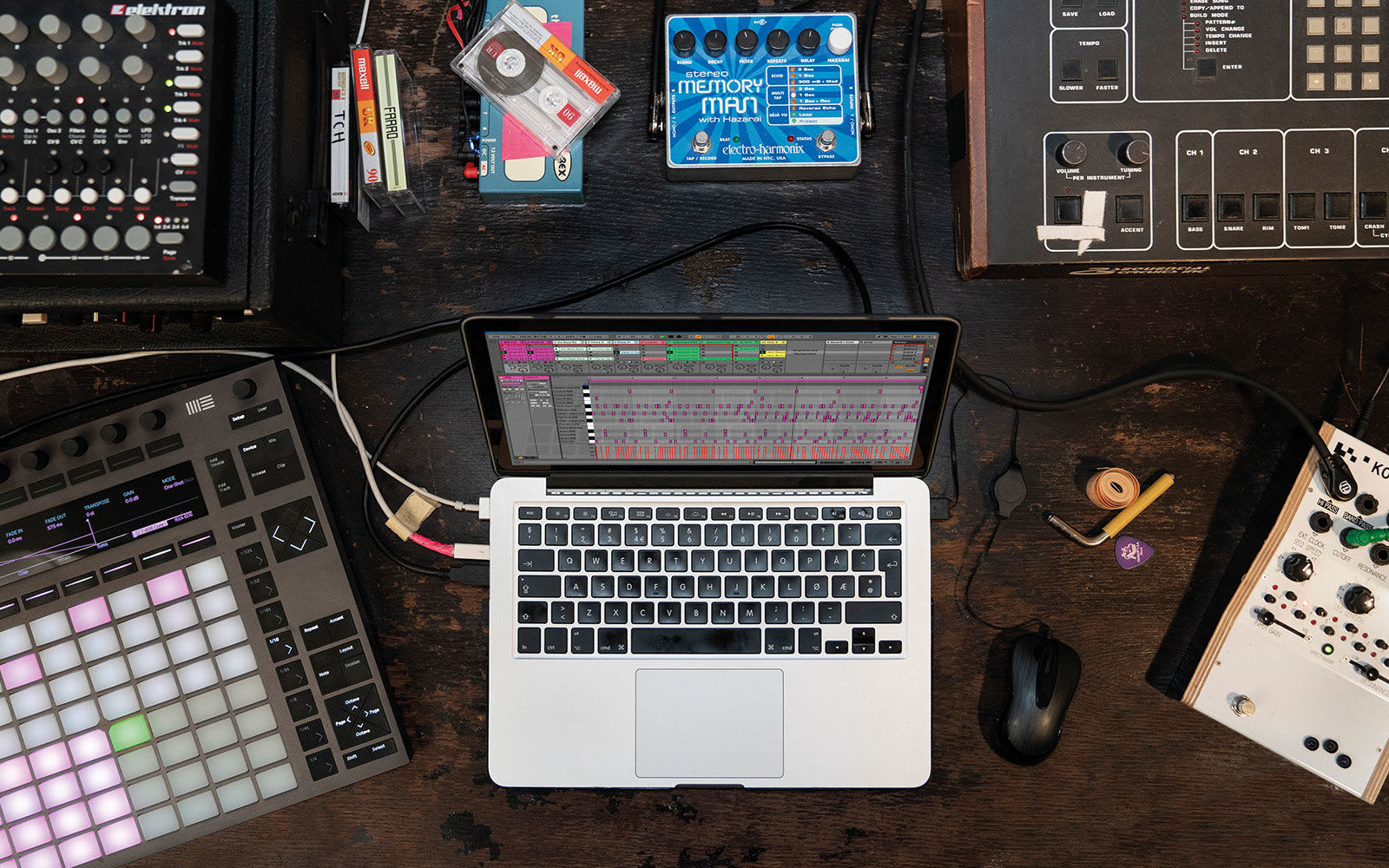
Maybe you’ve been inspired to build your own home recording studio. And maybe, you’re not quite sure where to start. Well, an audio interface, a good mic and a decent set of headphones will get you pretty far. But the first thing you’ll need is probably staring you right in the face: a computer.

Computer and a DAW

Ableton

Justin DeLay, Director of Product and Category Marketing at Reverb, drives home just how important the computer is: “You can strip away everything else and as long as you have a computer you can still create music,” he told me. He suggests you “spend the money on a good computer and get other gear — such as audio interfaces, mics, headphones, etc. — used or at reasonable price points.”

But, truthfully, you can do quite a lot with whatever computer you have on hand. Joe Pecora, the engineer and producer at Red Room Studio, says your set up “could be as simple as an iPhone/iPad with Garage band.” (I know someone who recorded an entire album this way.) While he agrees that the most important part is your computer, he argues it doesn’t have to be super powerful. It doesn’t even have to be a desktop. JDilla famously created many of his beats on a Roland SP303, and you can basically recreate that experience with an iPad and the $4 Koala Sampler for iOS. And don’t forget that Gorillaz recorded an entire album on an iPad.

Which leads us to the next thing you’ll need: a DAW, or digital audio workstation. If you’re a Mac user, then you’re lucky enough to have access to Garage Band, a surprisingly capable free option. And upgrading to Logic Pro X is only a $200 investment. If you’re on Windows (or just don’t like Logic), I often recommend Ableton Live (starting at $99). But honestly there are plenty of great options out there, like FL Studio, BitWig and Cubase all of which start at $99. And often, stripped down versions come free as part of a software bundle when you buy music-making hardware like MIDI controllers and audio interfaces.

Assuming you already have a computer and you just need the accessories to get recording, you can pick up everything you need for under $500 new. But, if you’re patient, you could build a well equipped bedroom studio with used gear for as little as $250.

MIDI controller

Engadget

Speaking of which, one of the first additions to your studio should be a MIDI controller. DeLay says this is a piece of gear often overlooked by beginners. “It’s not just for playing keyboard sounds,” he explained, “it can be used to write drums and percussion, to control mixes and more. It’s the creative interface of music production, and you don’t have to play the piano in order to harness its power.”

We’ve covered plenty of affordable and portable options before. But if you don’t plan to make music on the go, I can’t recommend the Arturia MiniLab 3 enough. It punches well above its weight, and even the pros love this thing. And if you have the space, it’s not much more to upgrade to something like the Keylab Essential 49 ($269) or Novation Launchkey 49 ($229), which will give you a lot more controls to play with.

Microphone

Audio-Technica

Unfortunately there’s no gear that will magically turn you into a breathy pop goddess, but a decent mic and audio interface can at least help you sound your best. Now, you could get a USB microphone, like Blue Microphones’ $130 Yeti, and it will certainly get the job done. Heck, that album I mentioned earlier was recorded using the wired headset that came with the iPhone.

But, honestly, your better bet is to get a regular XLR mic and an audio interface. Pecora specifically warns against splurging too much here. “People will look at their favorite artist and see that they use a certain mic or preamp or plugin and want to use the same thing thinking it will get them the same sound.” On early singles like “Ocean Eyes” Billie Eilish used an Audio-Technica AT2020 condenser mic, which costs just $100. And I’ve stuck almost exclusively with cheap Shure SM58s and 57s ($100 new, $50-$75 used) whether I was recording demos with my band in college or voice over for review videos at Engadget.

If you fancy yourself a future pop sensation and want to make sure your vocals are the star of the show, you could consider using a significant chunk of your budget on something like the Rode NT1-A ($229) or Shure SM7B ($390). You will get better results with more flexibility for post production, but you can clearly get excellent results with more affordable options.

Audio interface

Scarlett

As for the interface, there are tons of great options out there. Companies like Focusrite, Arturia and Tascam make excellent ones. But our new favorites in the budget interface space are Universal Audio’s Volt series. If your budget allows for it we strongly recommend the $299 Volt 276. Though, the $189 Volt 2 is also excellent, it just doesn’t standout from the crowd quite as much.

If you’re trying to save a few bucks, it’s hard to beat the Scarlett series from Focusrite (just make sure to get the second- or third-gen models). You can get the latest Scarlett 2i2 for around $130 used, but it’s just $180 new (and includes a huge bundle of very useful software).

The reason to opt for an audio interface instead of a simple USB mic is because it offers you a lot more flexibility and room to grow. For one, it offloads a lot of the audio processing from the CPU. Second, it will allow you to connect not just mics (and swap in different ones for different purposes), but also instruments, turntables or anything with an audio-out jack. An audio interface is also necessary if you plan to connect a pair of studio monitors.

Studio monitors and headphones

Will Lipman Photography for Engadget

This is an area that DeLay advises caution. While a good set of studio monitors will obviously be better than the speakers on your laptop and will result in a better mix, it’s too easy to get caught up in what he calls monitor envy. “The reality is that monitors at a $300 price point are going to work just fine in most spaces,” he says. Plus, your bedroom probably doesn’t have the space to really make the most of large, powerful monitors. So, save your money.

And if you’re just starting out, you’re probably better off getting a decent set of headphones. There’re tons of amazing and affordable studio quality headphones out there for under $200, like the $179 Beyerdynamic DT990PRO (currently down to just $179 on Amazon). But one of our favorites is an old workhorse from Sony, the MDR-7506. They’re well under $100 and actual pros have used them for decades to mix music.

One tip DeLay offers for novices: Double check your mixes in the real world. Headphones can over emphasize bass, while smaller studio monitors can have trouble delivering accurate bass response. So make sure to listen to your track on laptop speakers or in a car to get a sense of how it will sound in the wild.

And that’s really the key — have the patience to develop your skills and make the most of the gear you have. It’s really easy to catch a bad case of GAS (gear acquisition syndrome) when you’re first starting out — trust me, I know. But there’s no need to shell out thousands of dollars for high-end gear to start making music. You don’t even need to buy new gear. Pecora suggests the only thing you absolutely should buy new are headphones. And, presumably, that’s just because you don’t want to be wearing years worth of someone else’s sweat on your ears.


Generated by Feedzy
Exit mobile version