OpenAI brings its Codex coding app to Windows

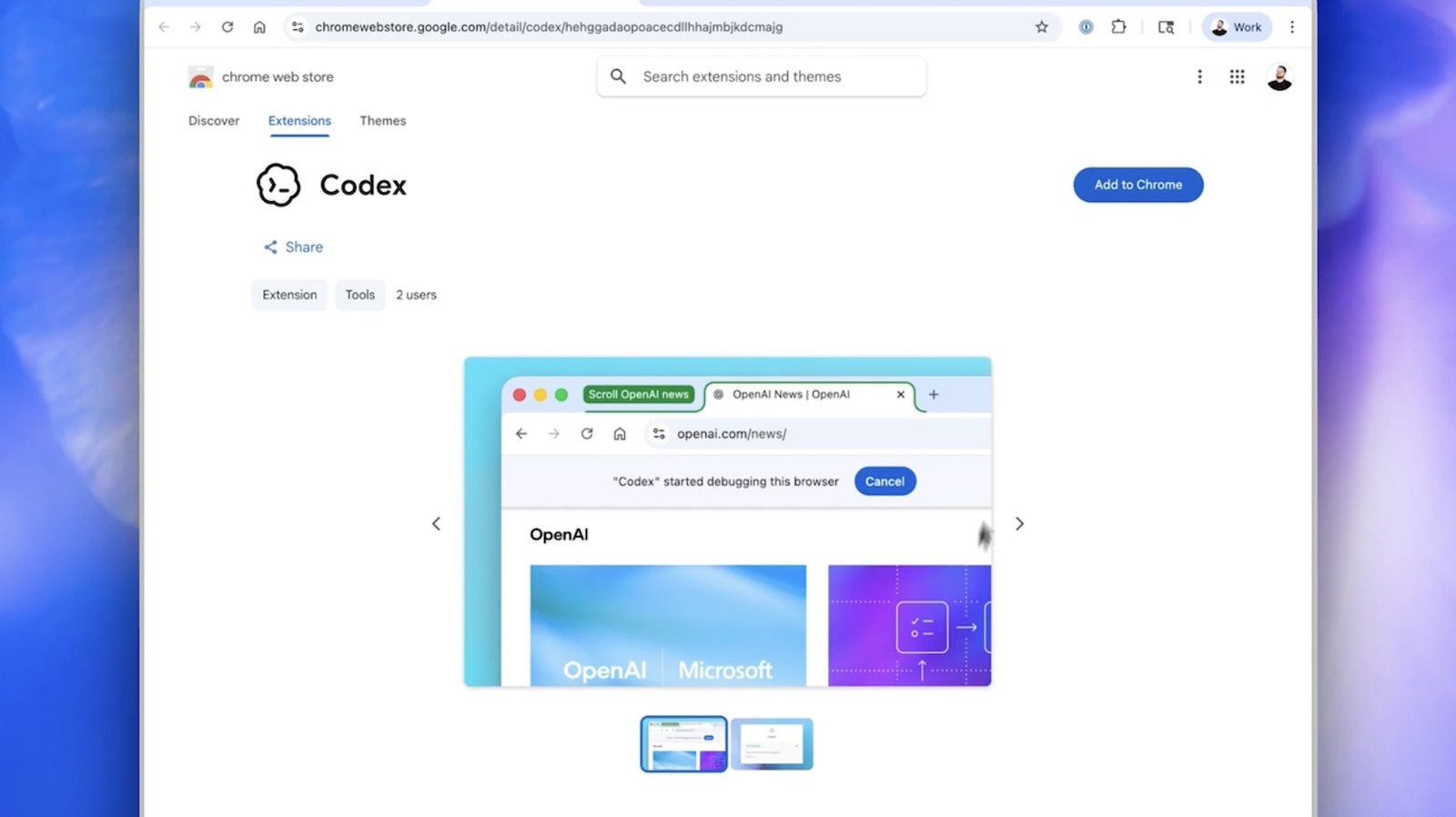
At the start of February, OpenAI upgraded its Codex coding app to give it the ability to manage multiple AI agents. At the same time, it released a standalone macOS app. If you’ve been patiently waiting for Windows to get that same treatment, OpenAI just released a dedicated Codex app for Microsoft’s operating system. 

The Codex app is now on Windows.

Get the full Codex app experience on Windows with a native agent sandbox and support for Windows developer environments in PowerShell.https://t.co/Vw0pezFctG pic.twitter.com/gclqeLnFjr

— OpenAI Developers (@OpenAIDevs) March 4, 2026

Like its macOS counterpart, the software allows you to coordinate multiple coding agents to work on the same task. There’s also support for automations to streamline repetitive tasks like bug testing. To help users get started, Codex includes a dedicated “Skills” section. Skills bundle together instructions, resources and scripts the software can use to connect agents to specific tools and workflows. OpenAI has also included native sandboxing to help make Windows developers feel at home. 

Codex is available to ChatGPT Free, Go, Plus and Pro users. If you decide to give the app a try, know that your session history is saved to your OpenAI account, meaning you can start coding on Mac and then move to Windows without losing your work.   

This article originally appeared on Engadget at https://www.engadget.com/ai/openai-brings-its-codex-coding-app-to-windows-195345429.html?src=rss 

Ooni debuts a rotating stone for its Koda 2 pizza ovens

When cooking pizza with the high heat of an outdoor oven, you have to rotate your pies to ensure even cooking. That’s usually done by hand, but Ooni’s latest accessory automates the process. The company announced the Rotating Stone for its Koda 2 lineup, which helps distribute heat evenly across the surface of a pizza so that it’s consistently cooked all the way around.

Ooni says its Rotating Stone has a mechanism around its perimeter rather than a central pivot. According to the company, this takes care of any wobbling or stalling that might otherwise occur — even when heavy cookware is used. The new accessory also has two rotation modes, continuous and 90 degrees, so you can conserve battery life if you don’t need the full range of motion.

The Rotating Stone’s external module houses a LIDAR sensor for hands-free control. By simply waving your hand or a pizza peel, you can start or stop the rotation. What’s more, Ooni says the Rotating Stone can be installed in less than 10 minutes.

The Rotating Stone is available for the Koda 2, Koda 2 Pro and Koda 2 Max for $329, $349 and $399 respectively. If you need the oven too, bundles are priced at $799, $1,099 and $1,649.

This article originally appeared on Engadget at https://www.engadget.com/home/kitchen-tech/ooni-debuts-a-rotating-stone-for-its-koda-2-pizza-ovens-200000857.html?src=rss 

LG reveals pricing for its 2026 OLED TVs

Now for the news you’ve been waiting with bated breath for: LG’s 2026 TVs from CES finally have prices. (Well, some of them do, anyway.) Surprisingly, the evo G6 and C6 series OLED TVs aren’t increasing in cost from last year’s models. But the bad news is, they’re still expensive as all get-out.

The flagship LG evo G6 series ranges in price from $2,499 to $24,999. (Cue spit take.) Fortunately, that five-figure price only applies to the 97-inch model, which nobody this side of Elon Musk needs. The entry-level price is for a 55-inch OLED. Moving up the ladder, the 65-inch one costs $3,399, the 77-inch model is $4,499 and an 83-incher will set you back $6,499.

The evo G6 line includes all the OLED upgrades from the head-turning LG Wallpaper TV, for which LG hasn’t yet announced pricing. You’ll find the company’s new “Hyper Radiant OLED” panel and optimizations to black and color levels in both lineups.

Meanwhile, the evo C6 line, which sits a notch below, ranges from $1,399 (42-inch) to $5,299 (83-inch). Rounding out the list is a 55-inch model for $1,999, a 65-inch one for $2,699 and a 77-inch model for $3,699. The C6 and G6 lines are powered by LG’s Alpha 11 AI Processor Gen3. Both series support gamer-friendly features such as 4K at 165Hz with VRR, NVIDIA G-SYNC and AMD FreeSync Premium.

The evo G6 and C6 lines are available to order today from LG’s website. Retail availability will follow later this month. Just keep in mind that, if you can hold off a little while, the entire history of TV pricing suggests you’ll soon be able to find them for less than MSRP.

This article originally appeared on Engadget at https://www.engadget.com/entertainment/lg-reveals-pricing-for-its-2026-oled-tvs-203923873.html?src=rss 

Humble Games’ former bosses buy the studio’s back catalog

Humble Games’ library has returned home, so to speak. Indie publisher Good Games Group (GGG), led by former Humble leaders, has acquired the full back catalog of over 50 Humble Games titles from Ziff Davis. Alongside the purchase, GGG has rebranded to Balor Games, positioning itself as a force in “triple-I” gaming.

“For the developers we have worked with over the years, this moment is a reunion,” Balor Games CEO Alan Patmore wrote in a statement. “[It has] the same leadership and the same commitment to thoughtful publishing remain in place. What changes is our scale and our focus. Balor Games is built for inventors and backed by believers. To that end, it exists to be a seal of quality for independent games.”

The Humble Games lineup includes (among others) Slay the Spire, A Hat in Time, SIGNALIS, Forager, Coral Island, Monaco and Wizard of Legend. Separate from the Humble transaction, Balor also bought the complete catalog of Firestoke Games (which shut down last August) and publishing rights to Fights in Tight Spaces. In total, the young studio now owns the publishing rights to over 60 indie titles.

Humble Games is separate from the Humble Bundle storefront. The latter is still owned by Ziff Davis.

Alan Patmore (l) and Mark Nash

Balor Games

The seemingly happy ending comes after quite the rocky road. In July 2024, Ziff Davis laid off all 36 employees of Humble Games. But later that year, Humble Games’ former leaders (Patmore and Mark Nash) formed GGG and cut a deal to help manage their old studio’s back catalog. Now, with Ziff Davis in a selling mood, that library is back in Patmore and Nash’s hands. Balor Games, it is.

The pair view the newly anointed Balor as a developer-friendly publishing house. As for its name, Balor is a supernatural being in Irish mythology. It’s sometimes depicted as having three eyes. Triple-eye, triple-I… Clever devils!

The triple-I moniker is a more recent addition to the gaming lexicon. It typically means something defined by indie creativity and passion — with a budget far less than AAA but more than a tiny two-person passion project. (Balor says it’s about “high-quality, impactful games.”) You wouldn’t be blamed for wondering how that’s different from AA. But the slant here is to define the genre less by budget and more by “indie” intangibles.

Nash detailed the company’s vision in an interview with GamesIndustry.biz (which, curiously, is a Ziff Davis property). “We felt that what’s becoming more and more critical is that as game development becomes more diverse, more complicated, and expectations continue to rise, we feel it’s important that a publisher can match the needs of each individual project,” Nash said. “We are spending a considerable amount of time with anyone we are partnering with, figuring out what they need specifically.”

This article originally appeared on Engadget at https://www.engadget.com/gaming/humble-games-former-bosses-buy-the-studios-back-catalog-183831194.html?src=rss 

MacBook Neo vs. M5 MacBook Air: All the trade-offs you’ll make to save $500

Apple is looking to gain a foothold in the more budget-friendly end of the laptop market with the MacBook Neo. The system starts at $599, which is darn inexpensive for an Apple laptop — it even has the same starting price as the M4 iPad Air.

As such, the MacBook Neo should help Apple compete with cheap Windows laptops and Chromebooks. Pricing it at $499 for educational use won’t exactly hurt either.

Apple is really lowering the cost of entry for those looking to pick up a new MacBook here. The base MacBook Neo costs $500 less than the cheapest M5 MacBook Air, which is now officially Apple’s midrange laptop.

Of course, there are a lot of tradeoffs you’ll make by opting for a MacBook Neo instead of a MacBook Air. If you’re curious about all the differences between the Neo and the base 13.6-inch Air (and perhaps what you’ll be foregoing if go you with the cheaper option), we’ve got you covered.

MacBook Neo vs. MacBook Air exteriors

Apple

Let’s start with the things you’ll notice at first glance about the two laptop lines. The Neo has an arguably more eye-catching array of colorways with silver, blush (a light pink), citrus (light yellow) and indigo options. The Air comes in a more muted batch of sky blue, silver, starlight (a sort of champagne) and midnight (a very dark blue).

The weight of the two laptops is identical at 2.7 pounds and the differences in the dimensions are negligible. Blissfully, both laptops have a headphone jack. Please have the courage to keep those around in MacBooks, Apple.

Apple

Alas, the Neo does not have a MagSafe port, so you’ll need to use one of its two USB-C ports (it has one USB-C 2 port and a USB-C 3 port) for charging. The MBA has two Thunderbolt 4 (USB-C) ports to go with its MagSafe connector.

While we’re on the subject of charging, the MacBook Neo comes with a 20W power adapter. The MBA includes a 40W Dynamic Power Adapter with 60W Max, and it supports fast charging at up to 70W. 

The Neo has a 36.5-watt-hour lithium-ion battery, which Apple claims has enough juice for up to 11 hours of web browsing or 16 hours of video streaming on a single charge. As for the MBA, that has a 53.8-watt-hour lithium-polymer battery. Apple says you’ll be able to use that laptop for 15 hours of web browsing or 18 hours of streaming video before you need to recharge.

Back to the exterior of the laptops and in terms of audio, the Neo has a side-firing dual-speaker system with Spatial Audio and Dolby Atmos support. However, unlike with the MBA (which has four built-in speakers), there’s no mention of Spatial Audio support for AirPods. The MBA has one more microphone than the Neo as well, and both laptops support Voice Isolation and Wide Spectrum microphone modes.

MacBook Neo vs. MacBook Air opened up

Apple

If you were to place a MacBook Neo and MacBook Air side by side and open them up, you might spot that the former’s screen is a little smaller at 13 inches on the diagonal. While both have Liquid Retina displays with 500 nits of brightness, the Neo’s screen has a lower resolution of 2408 x 1506 vs. the MBA’s 2560 x 1664. The Air also has a P3 wide color gamut and support for Apple’s True Tone feature, which tweaks the screen’s color temperature to better fit your surroundings. The Neo has an sRGB display instead.

While the webcams in both laptops can capture 1080p video, the one in the Neo is lower-specced and has fewer features. It’s a 1080p FaceTime HD camera. The MBA has a 12MP camera that supports Center Stage, a feature that keeps you in the middle of the frame as you’re moving around. It also supports Desk View, which allows you to show your face and what’s on your desk simultaneously. 

The MacBook Neo has a Magic Keyboard and multi-touch trackpad (which we didn’t feel were super sturdy in our initial hands-on time). The MacBook Air, on the other hand, has a backlit Magic Keyboard and a Force Touch trackpad. It also supports Touch ID as standard.

If you want Touch ID on the MacBook Neo, though, you’ll need to pay extra. A version of the laptop with Touch ID costs $699. That upgrade (which is the only one available for the Neo as things stand) also doubles the internal storage to 512GB. And that feels like a smooth segue into comparing the internal specs of each machine.

MacBook Neo vs. MacBook Air on the inside

The M5 MacBook Air comes with 512GB of storage as standard and you can equip it with up to a 4TB SSD. The Neo tops out at 512GB.

It’s a little disappointing (though somewhat understandable given the surging costs of RAM) that the Neo only has 8GB of unified memory. That’s half of what you get in a MacBook Air as standard, and you can expand that laptop’s RAM to 32GB. Memory bandwidth is nearly three times faster on the MBA as well at 153GB/s, compared with 60GB/s on the Neo.

The chip that runs the Neo is significantly less powerful than the M5 you’ll find in the MacBook Air too. The Neo uses an A18 Pro, which is the chip that debuted in the iPhone 16 Pro and iPhone 16 Pro Max. It has a 6-core CPU (two performance, four efficiency), 5-core GPU and 16-core Neural Engine. Measure that against the Air’s M5, the base version of which has a 10-core CPU (four super cores, six efficiency cores) and 8-core GPU, though that too has a 16-core Neural Engine.

We don’t yet have a direct comparison, such as Geekbench 6 scores, to directly measure the performance of each laptop. However, it’s already clear that the MacBook Neo won’t be nearly as powerful as the M5 MacBook Air. You probably won’t be doing heavy-duty video editing on a Neo. That said, Apple says that you will be able to use Apple Intelligence features on the laptop.

This article originally appeared on Engadget at https://www.engadget.com/computing/laptops/macbook-neo-vs-m5-macbook-air-all-the-trade-offs-youll-make-to-save-500-less-190434959.html?src=rss 

Ubisoft confirms Assassin’s Creed: Black Flag remake

Ubisoft has officially confirmed that it’s working on a remake of Assassin’s Creed: Black Flag. This remake has been rumored for years. After all, the 2013 original is one of the most beloved entries in the franchise.

The official title is Assassin’s Creed: Black Flag Resynced, and that’s about all we know for sure. The company released some concept art but it’s just protagonist Edward Kenway hanging out on a boat.

Reports have suggested that this will be a substantial remake, with visual and gameplay upgrades to make it comparable with last year’s Assassin’s Creed Shadows. It’s also been rumored that this version will cut out all of the modern day gameplay sections, focusing entirely on pirate-themed action.

We don’t know when Ubisoft will release this thing into the world, but the company did recently say that a previously unannounced game would be released by the end of the coming financial year, which happens on March 31, 2027. At that time, Black Flag Resynced had yet to be officially announced. It’s possible we could be playing this thing sooner rather than later, particularly if the company has been working on it for years.

This announcement came as part of a franchise roadmap, which included a slight mention of the next mainline Assassin’s Creed entry. This is being developed under the name Codename Hexe, with Ubisoft promising a “unique, darker, narrative-driven Assassin’s Creed experience set during a pivotal moment in history.”

The creative director of that one, Clint Hocking, recently left the company after a 20-year tenure. He’s been replaced by Jean Guedson, who had the same job for the original Black Flag 13 years ago.

This article originally appeared on Engadget at https://www.engadget.com/gaming/ubisoft-confirms-assassins-creed-black-flag-remake-193629862.html?src=rss 

Google ends its 30 percent app store fee and welcomes third-party app stores

Google is officially doing away with its 30 percent cut of Play Store transactions, and rolling out changes to how third-party app stores and alternate billing systems will be handled by Android. Some of these tweaks were proposed as part of the settlement the company reached with Epic in November 2025, but rather than wait for final judicial approval, Google is committing to revamping Android and the Play Store publicly.

The biggest change is to how Google will collect fees from developers publishing apps on Android. Rather than take its standard 30 percent cut of in-app purchases through the Play Store, Google is lowering its cut to 20 percent, and in some cases 15 percent for new installs of apps from developers participating in its App Experience Program or Google Play Games Level Up program. Google will also now charge a five percent service fee for developers in the UK, US or European Economic Area using its billing system, and “a market-specific rate” in other regions. Of course, for anyone trying to avoid those fees, using alternatives to Google’s billing system is also getting easier.

As part of these changes, Google says that developers will be able to offer alternative billing systems alongside its own or “guide users outside of their app to their own websites for purchases.” The setup, as described by Google, appears to be more permissive than what Apple settled on in 2025. For iOS apps on the App Store, developers interested in avoiding Apple’s fees can only direct customers to alternative payment methods on the web through in-app links. Allowing for these outside transactions is part of what prompted Epic to bring Fortnite back to the App Store in the US in May 2025. The developer added the app back to the Play Store in the US in December of that year, and Epic CEO Tim Sweeney shared alongside today’s changes that Fortnite will soon be available in Google’s app store globally.

Fortnite will return to Google Play Store worldwide soon. Epic Games Store continues supporting Android worldwide alongside Windows and Mac, and installation on Android will become much easier later in 2026.

— Tim Sweeney (@TimSweeneyEpic) March 4, 2026

Epic is ultimately interested in getting people to use the mobile version of its Epic Games Store, and Google’s announcement includes details on how third-party app stores can come to Android. Third-party app stores will be able to apply to the company’s new “Registered App Stores” program to see if they meet “certain quality and safety benchmarks.” If they do, they’ll be able to take advantage of a streamlined installation interface in Android. Participating in the program is optional, and users will still be able to sideload alternative app stores that aren’t part of the program, but Google clearly has a preference.  Changes the company plans to make to sideloading later in 2026 could deliberately make the process more difficult, which might force developers to play ball anyway.

App stores approved by the Registered App Stores program get a simpler installation interface.

Google

Developing…

This article originally appeared on Engadget at https://www.engadget.com/apps/google-ends-its-30-percent-app-store-fee-and-welcomes-third-party-app-stores-185248647.html?src=rss 

iPhone 17e hands-on: Pretty in pink, with portraits enabled

The iPhone 17e was announced on Monday through a press release, so there was no real chance to immediately get a hands-on with it. But at Apple’s event in New York today, the phone was on display alongside the new MacBook Neo, iPad Air M4, MacBook Pro M5 and Studio Display XDR. I managed to take it for a quick spin to see if it is truly as similar to the iPhone 16e as it appeared from pictures. Spoiler: It mostly is.

One of the most noteworthy changes to the iPhone 17e is the addition of MagSafe support, and aside from confirming whether that works, I don’t really have any impressions to add. I also can’t tell you at the moment whether the increased wireless charging speed makes a difference, although mathematically I have to imagine it would.

I did get a chance to try out the new Portrait photography here. I brought my iPhone 16e and tried taking portraits with both devices. I could immediately see that the iPhone 17e allowed me to apply an artificial background blur to pictures I was framing up of the new MacBook Air M5, whereas my iPhone 16e just said “No person detected.” In the Photos app, I was able to adjust the level of blur and adjust the focal point to bring a different group of flowers in focus, too.

The other thing I can tell from seeing the iPhone 17e in person is that this new pink color option is absolutely delightful. I won’t go as far as to call it stunning or vibrant — it’s too subtle to be either of those things. It’s almost the same shade of pink as the Pixel 3, except a bit rosier. I do really like this color, it’s understated and elegant.

Other changes include the stronger Ceramic Shield 2 covering the iPhone 17e’s screen, which is a step up from the Ceramic Shield on the iPhone 16e. Obviously I didn’t attempt to throw the new phone around at this event, and would not have been allowed to, so we’ll have to wait till I spend more time with a unit in the real world to better gauge its durability.

I’ll also work on testing things like battery life, charge time and performance improvements with the A19 chip in my full review. For now, my early look at the iPhone 17e tells me everything I expected is largely true, and that pink is a surprising scene stealer. The iPhone 17e retails for $599 and is available for pre-order now, with in-store and shipping arrivals slated for March 11.

This article originally appeared on Engadget at https://www.engadget.com/mobile/smartphones/iphone-17e-hands-on-pretty-in-pink-with-portraits-enabled-163946647.html?src=rss 

Generated by Feedzy
Exit mobile version